Category: Project
the Orel city will celebrate the millennium. Archaeological excavations have clarified the new date of the city’s existence.
In Orel, six years later, excavations were resumed by specialists of IA RAS under the leadership of the head of the Seiminsko-Sudzhinskaya expedition – O.A. Radyush, on the site of the stronghold of the Orel fortress with the support of the Governor of the Orel region A.E. Klychkov and the 1XPEDITION project. Even today, artifacts allow us to confirm one of the hypotheses about the foundation of the city.
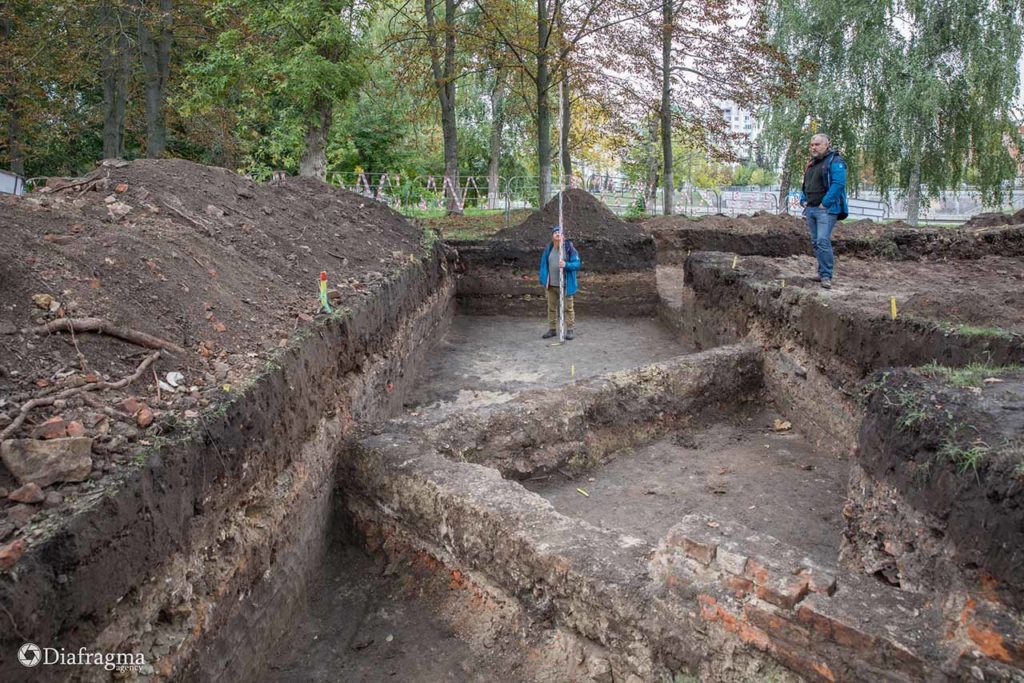
While the townspeople celebrated another anniversary – 455 years, researchers are arguing among themselves. There is an opinion that the Orel is older than its years. It appeared long before 1566, when, on the instructions of Ivan the Terrible, a fortress was founded at the confluence of the Oka and Orlik rivers to protect the southern borders of the Moscow state. There is a legend, saying that the king stopped at the confluence of the Oka and Orlik rivers. And it was at that moment a huge eagle landed on the branches of an oak tree growing there. Grozny considered this a good sign and ordered to lay the fortress, and the bird allegedly gave it a name. However, history experts have long suggested that the settlement at this place may have existed in the XI or XII centuries.
In 2015, archaeological work took place on the site of the stronghold of the Orel Fortress, in which a slate spinning wheel was found among many artifacts.

It suggests that settlements at the confluence of the Oka and Orlik existed in the XI-first half of the XIII century. But it is impossible to draw conclusions based on a single finding. Also, during the work, the researchers came across a mass grave – probably the first in Orel. At least, it is the oldest known one. Previously, they did not know about it, although they assumed that the churchyard could exist.

As Oleg Radyush, a researcher at IA RAS, noted: – The remains of more than twenty people, including women and children, were found. The churchyard probably existed from the XVI – early XVIII centuries. It was the nobility who was buried: good teeth, tall stature, jewelry. One of them had an arrowhead stuck in his bones – evidence of events four hundred years ago.
Today’s research continues on the remains of buildings that were discovered in 2015. Archaeologists managed to localize the remains of the Nativity Church in its brick version. In the excavation, you can observe its collapsed walls. The Nativity Church with the chapel of the Assumption of the Virgin was built in 1730 to replace the very first wooden cathedral of the city of Orel. It was one-domed, two-storied with a stone bell tower and porch and was “a church not very extensive and moderately decorated.” The Church of the Nativity existed for a relatively short time. Constant flooding of the arrow led to the fact that the water of the Oka and Orlik washed away the walls, cracks went along the facade, and the bell tower tilted threateningly. In 1786, the Nativity Church was dismantled. As it was found out during the excavations, the temple was built without a strong foundation and of very poor-quality bricks, which affected its fragility.
Around the remains of the structure, history experts discovered a necropolis that existed from the second half of the XVI century. – until the beginning of the XVIII centuries. It was partially destroyed during the construction of the Nativity Church in the 1730s. The cemetery consists of two or even three horizons. The first is graves let into the mainland (that is, into clay), which include several burials, including the largest. They most likely date back to the troubled time, that is, these are the times of Ivan Vasilyevich and Fyodor. The remains found belong to physically developed people with tall stature, which is unusual for peasants. There are skeletons with a height of 183 cm, which for that time it can be considered very tall. There are a lot of injuries on the bones. Moreover, the fractures are fused, which suggests that the victims received many injuries. We can see the very people – the defenders of the fortress, who were buried in the era of Ivan the Terrible. These were representatives of the nobility who participated in all the battles of that period, as well as their families. The burials are localized from about 2 meters below the modern surface, and the bottom was up to 3 meters. In the layer, there were also coins of scales from the times of Ivan the Terrible, Mikhail Fedorovich, Alexei Mikhailovich, arrows, etc.

The foundation of another building was found nearby. Judging by the plan of 1728, the only and earliest image of the Orel fortress, this is a large voivodeship hut. The foundation consists of stone, and the building itself was most likely wooden, – says the head of the expedition. An encryption-quadrivium was found nearby, indicating the noble origin of the owner of the object.

The upper cultural layer in the excavation is represented by coins of Peter I, Anna Ioannovna, Elizabeth, Paul I, etc. Household items – remnants of stoves, stove tiles, all kinds of glass pharmacy and perfume bottles, rings, buttons, and other accidental losses. Since the houses in this place were rebuilt, we can observe the tiles of the beginning of the XVIII and XIX centuries. That is all evidence of the material culture of that time.

The most intriguing finds of this expedition were a coin of the middle of the XI century from Northern Germany. A hanging seal, weight from the scales of about the XI century, and across of the XII-XIV. As was noted by the Doctor of Historical Sciences, corresponding member of the Russian Academy of Sciences, Deputy Director of IA RAS Pyotr Grigoryevich Gaidukov: – the princely seal with the inscription DNE WORD dates from the end of the XI – first half of the XII century. On it is placed the image of St. Nicholas. But it is not yet possible to attribute it to any particular prince.

It is known from history that the place of study in the XI-XII century was part of the Zvenigorod-Karachevsky Principality, which in turn belonged to the principality of Chernihiv. If earlier it was possible to assume that there was a small ancient settlement on the site of the city, now there is reason to conclude that an important trade and administrative center is standing on international routes, which is also confirmed by the coin found, weight from the scales and across.

Researcher at the Department of Archaeology and Antiquities of Stockholm University Kuleshov V.S. determined that the coin belongs to the German Empire, the city of Groningen of the period 1040-1050.
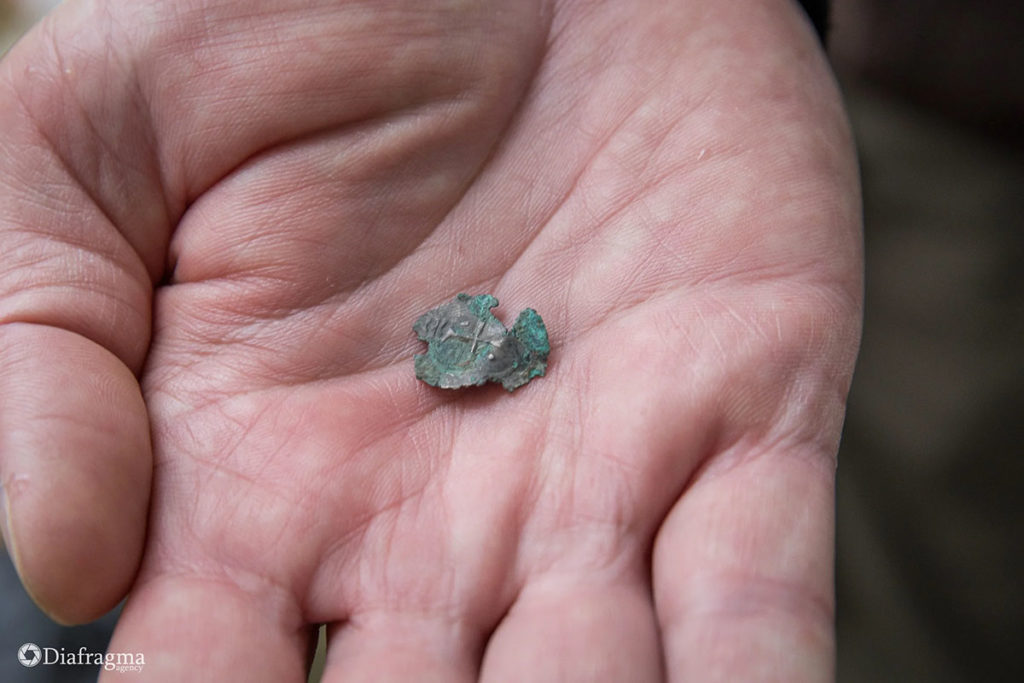
As you know, coins are the main evidence dating the emergence of any city. Thus, the reliable dating of the settlement (settlement) on Strelka refers to the second half of the 11th century. To the end of the Viking Age and the existence of a well-known system of trade routes from the Baltic to the Black and Caspian Seas, one of the points of which was a fortified settlement on the Oka and Orlik arrow on the site of the modern Orel.
This year, during the security work at the Red Bridge, the remains of the building were found with traces of a strong fire throughout the area. Archaeologists have collected an extensive collection of ceramic tableware of the XI – first half of the XIII centuries, iron knives and petiole arrowheads, a buckle frame and a fragment of a non-ferrous metal hatchet pendant, as well as slate weights for a hand spindle (spinning wheel) and fragments of glass bracelets. New data give reason to believe that in the historical part of the Orel. From the site near the modern Red Bridge to the arrow at the confluence of the Orlik River with the Oka, there was a large settlement center that disappeared in the pre-Mongol period.
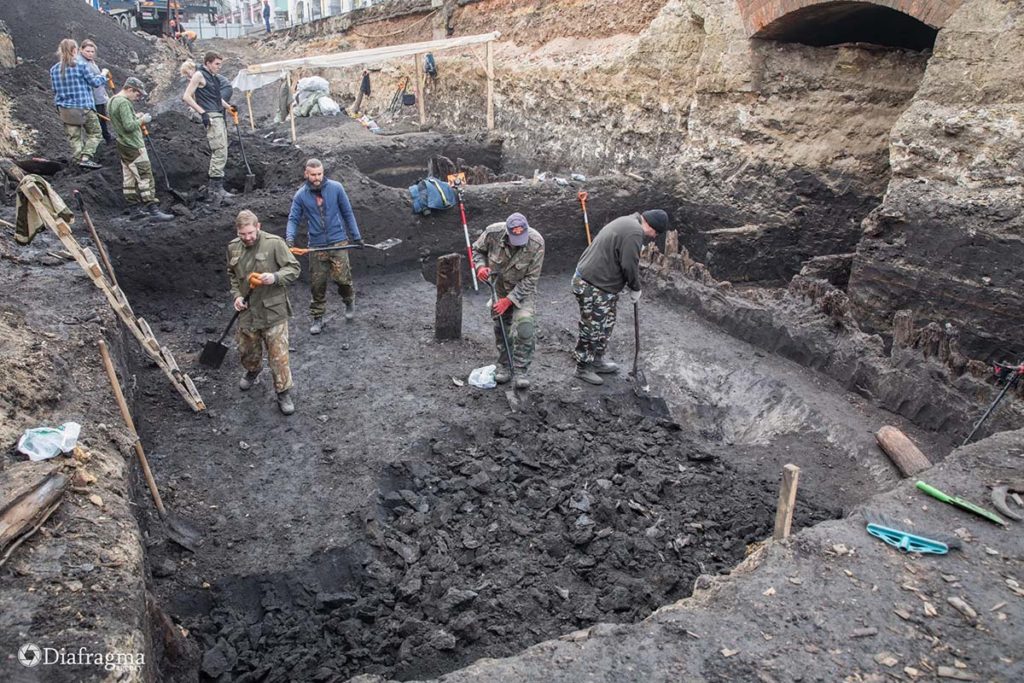
Archaeological excavations by IA RAS specialists under the leadership of the head of the Seiminsko-Sudzhinskaya expedition – O.A. Radyush, on the site of the stronghold of the Orel Fortress with the support of the Governor of the Orel region A.E. Klychkov and the 1XPEDITION project became the first step towards writing a new history of our hometown of Orel, which has aged 500 years before our eyes.
The project “Resset. Gutorovsky Frontier” is a continuation of work on the introduction of innovative underwater search technologies to detect the remains of Red Army soldiers and elements of military-technical history, which are located at the bottom of rivers, along the course of which the front line passed in 1941-1943.
TIn October 2021, we went to the Kaluga region (300 km south of Moscow) to find material evidence of the bloody battle of October 13, 1941 and the remains of its heroes.
On that terrible day, not far from the Yalutorovsky sawmill, the 154th Rifle Division was crossing the Resset River under continuous fire from the German army. This is how eyewitnesses described this day:
“… there were so many people, carts, cars, guns, tractors in the swamp near the Resset River that it was possible to pass only by sneaking under the bellies of horses, under the drawbars of bricks or cracks between cars. The swampy ground buckled underfoot like canvas, under the wheels it burst with a dull exhalation. Guns, carts lay belly down on the rusty, trampled hard grass caught by the frost, and it was impossible to pull them out, and there was nowhere to drag them. Every 5 minutes in the river, where the remains of the log bridge were still visible, shells were laid in bundles…”
By the middle of the day, most of the 154th division successfully crossed the river on the bridge, but the heavy vehicles and the Katyusha division could not be transported — the Germans discovered the crossing and opened artillery and mortar fire on it. One of the bombs hit the bridge, tore off the flooring and scattered the ZIS-8 buses that served as supports. Some of the cars sank, and the Gutorovsky frontier became a mass grave of almost 100 thousand soldiers of the 50th army.
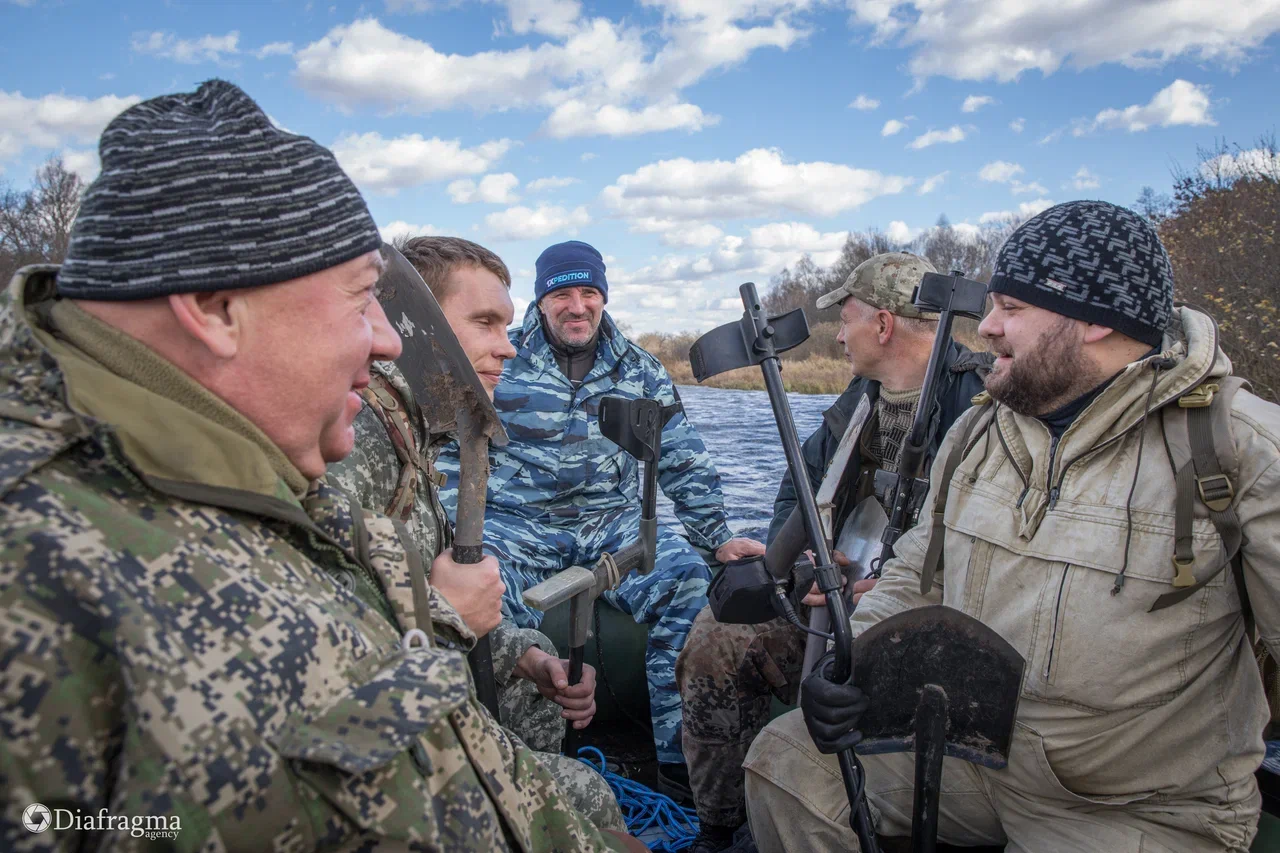
2On October 22, 2021, we arrived at the ferry site in search of the remains of fallen soldiers and material evidence of the past. In order to make the expedition as effective as possible, we have combined underwater search technologies with a survey of the coastline with metal detectors.
On the shore of the Resset, the expedition participants set up a camp, equipped recreation and food areas around the campfire, and also installed a diving post.

A group of divers began exploring the riverbed using side-view sonar. The operator of the device determined the location of the most interesting anomalies, after which the divers dived and carefully examined these areas of the bottom.
Extremely low water temperature, poor visibility and difficult terrain hindered the search, but excellent company, good mood and well-coordinated work of the team gave strength and maintained faith in the success of the expedition.
On the very first day, the divers of the 1XPEDITION project found traces of the battle under the water – scattered logs and a huge number of metal signals in the muddy sediments of the bottom. The findings allowed us to localize the exact location of the crossing.

In parallel with the divers, another part of the search group examined the coastal zone using metal detectors and probes.
At the bottom of the river we found a huge amount of military ammunition: belts, gas masks and pouches, and on the shore — a scattering of shells from Mosin’s rifle.
In the midst of underwater search operations, we came across a large metal object and decided to lift it to shore with the help of lifting parachutes for detailed study. The artifact was torn from the silt and moved to dry land.
All the participants of the project gathered to look at the find — we had a 1941 ZIS engine from heavy machinery in front of us. Some elements of the structure rotated freely with their hands even after 80 years, due to the fact that the mechanism was almost completely silted up all these years.
Its production began in 1932 — trucks and buses worked on it in peacetime. ZIS functioned perfectly on any fuel, its efficiency did not fall even on kerosene. And it was during the Second World War that they began to install it on ZIS-5 trucks, which served as the chassis for the legendary Katyusha rocket launchers, which terrified the German army.

In the process of careful inspection of the coastal zone, we often came across items of ammunition of soldiers of the Red Army: pouches, buckles and gas masks. Unfortunately, we could not find the unburied remains of the fighters. At the end of the expedition, divers localized the frame from a heavy car, but it was decided to leave its extraction for the next time.
Thanks to the project, we were able to look into the past and touch the history of the “Gutorovsky frontier” – a place of sacred memory and heroism of Russian soldiers. The battle artifacts discovered during the expedition were transferred to the museum of the Military Patriotic Club Search Association “Breakthrough” for further study and preservation as historical evidence of the battle of the Second World War.


The history of the first and unsuccessful campaign of Tsar Ivan the Terrible to Kazan is shrouded in secrets and riddles for many centuries. Scientists reflect on the event that took place on February 4, 1548, near the village of Rabotki, Nizhny Novgorod region, which stopped the offensive of the Russian army.
The DIVO Oryol Scuba Diving Club and scientists from the Institute of Archaeology of the Russian Academy of Sciences, within the framework of the 1XPEDITION project, studied the Volga water area and coastline for almost two weeks in September to shed light on this story. And it seems that this work will be the first step towards the discovery of a global scale.

The uniqueness of the place
The village of Work was chosen as the site of the expedition, not by chance. This year divers of the DIVO club found the place of the Sudbischenskaya battle in the Orel region. This battle took place during the reign of Ivan the Terrible. This extraordinary personality of our history left behind a lot of riddles. One of them was shared by experts in the artillery of the Ivan the Terrible era. This is a legend about an event that took place near the village of Rabotki, Nizhny Novgorod region. This place stores answers to questions not only about the mysterious incident of February 4, 1548 (the time of the tsar’s first campaign on Kazan), but also unique knowledge about the artillery of the XVI century, which is extremely scarce today.
According to historical data, the Kazan Khanate has been waging an intense struggle since the XV century as the “state of all Russia”. Moscow tried to establish control over Kazan, but the efforts were in vain. In 1535, Safa-Giray, who hated Russia, took the khan’s throne. The confrontation of the “neighbors” seriously intensified before the war.
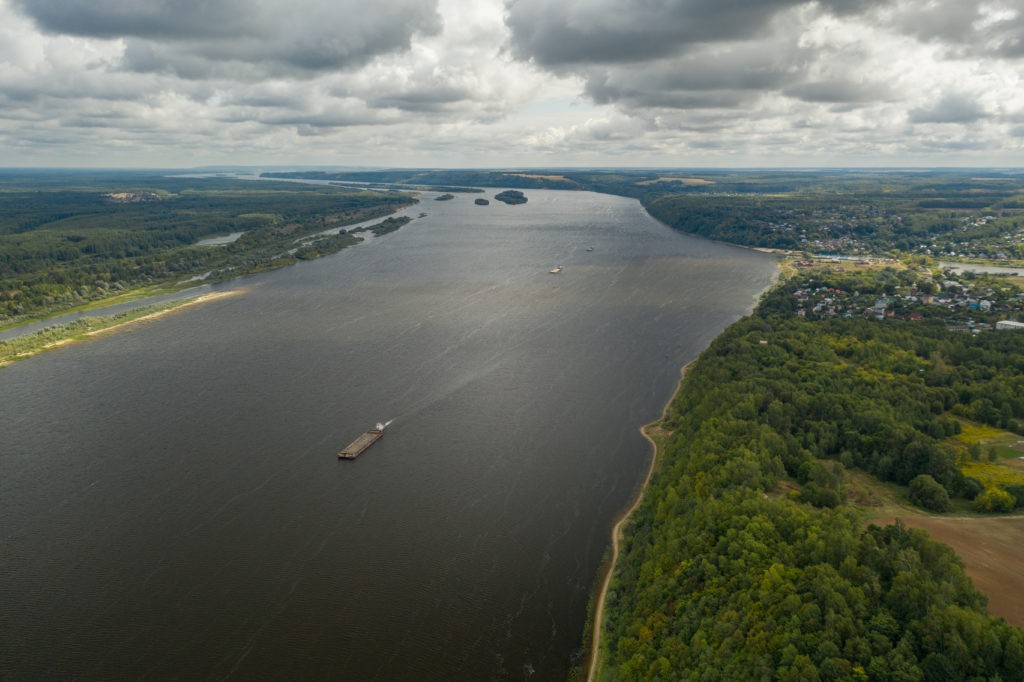
In December 1547, the young tsar Ivan IV, after a long preparation, went on his first campaign to Kazan. According to Oleg Radyush, an archaeologist, researcher at the Department of Archeology of the epoch of the Great Migration of Peoples and the Early Middle Ages of the Institute of Archaeology of the Russian Academy of Sciences, the tsar’s army went overland, and heavy artillery – on the ice of the Volga. Sixty kilometers east of Nizhny Novgorod, in the area of Rabotka, on February 4, 1548, the tsar’s campaign against Kazan suddenly stopped.
— There was a very unpleasant incident in the area of the modern village of Rabotki. The flood that started early led to the fact that the ice cracked, and the artillery outfit went to the bottom of the river,” Radyush said.
Because of this incident, many people died. The Russian army lost the most necessary part of its artillery. It took several years to restore it.
To date, scientists are asking various questions about the event that took place on the Volga on a mysteriously warm day in February, trying to find out the exact place, where the artillery outfit sank. After all, some historians do believe that the campaign was stopped. Why? Because of a sudden thaw and the inability to continue along the Volga, and not because of a sunken wagon train.
Finds
Sixteen people took part in the expedition as part of the 1XPEDITION project. Divers and specialists of the Institute of Archaeology of the Russian Academy of Sciences for 12 days with the help of side-view sonar and underwater metal detectors examined about 80 hectares of the bottom of the Volga River. The depth of the dive ranged from 8 to 12 meters, which was facilitated by difficult conditions of poor visibility and strong currents.

As the head of “DIVO” Sergey Kulikov said, during the expedition, the participants were so keen on solving the mysteries of history that they did not we noticed how time passed quickly: the search continued from early morning and ended only with darkness.
— We carried out work both in the rain and under the scorching sun, the weather changed several times a day. I didn’t even want to rest, the main thing was the search,” Kulikov said.
Divers are no stranger to working in this mode. – We have been traveling along the Volga for many years, “we passed it from Tver to Kazan,” Kulikov stressed.
Among the finds, fans, history in the area of the village of Work at the bottom of the Volga — a large number of metal household items from the beginning of the XX century to our days, but the most important find is an artillery shell, possibly from the time of Ivan the Terrible.
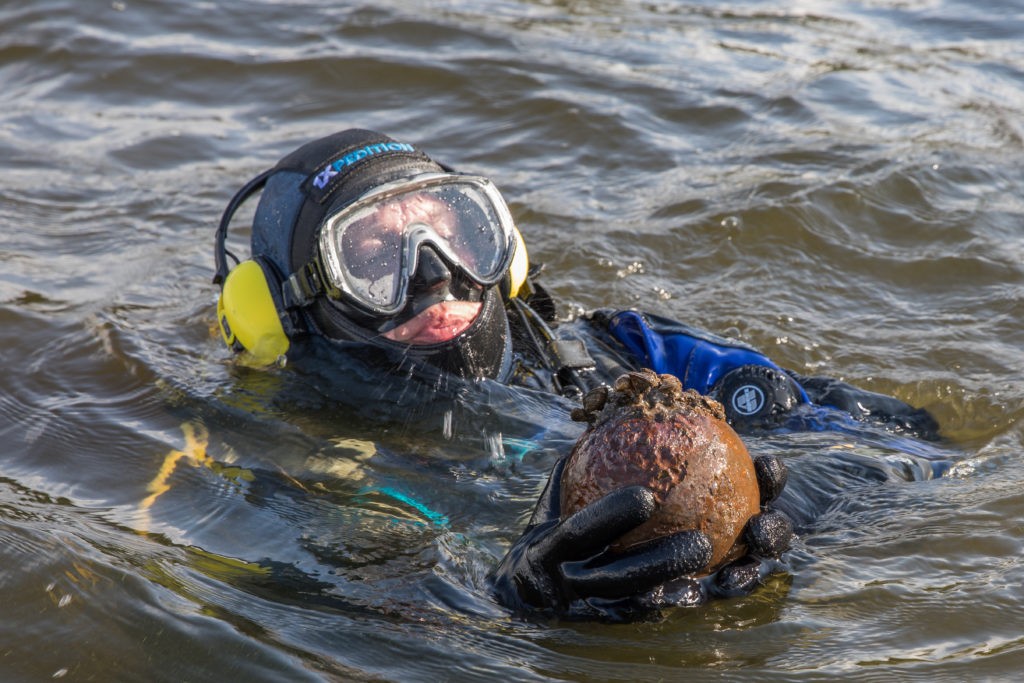
— There were a lot of finds. It’s just metal, old tools, household items, the most intriguing thing is the core. Of course, I would like to find guns, but it is clear that not every expedition ends with a sensational find. We did not expect that this expedition would bring us at least one priceless find, but there is a result, and this is already a success—” Kulikov said.
The uniqueness of the found core is that it makes it possible to confirm the legend of the sunken artillery outfit of Grozny in the vicinity of the village Work and help localize the exact location. An interesting find of the expedition within the framework of the 1XPEDITION project has been handed over to IA RAS specialists for further study.
The search continues
According to Radyush, such expeditions will continue: “it is difficult to overestimate their significance for history and archeology.” At the same time, the subsequent activities of divers and archaeologists will take place using more modern technology and geophysical methods.

– Ancient communication routes, ancient cities that remain underwater, ships that have sunk and their cargoes – all this leaves its traces and is well preserved underwater and gives important scientific results. Therefore, it is of great interest to us to cooperate with divers in the exploration and study of various objects. A huge number of ancient secrets are hidden at the bottom of the sea, river, lake,” the scientist said.
He emphasized that the discovery of the remnants of Grozny’s outfit, taking into account the avarice of knowledge about artillery of the XVI century, will be a grand discovery for the scientific community for at least decades.
– The uniqueness of these guns is that they have practically not been preserved. The only one of them is represented in Moscow, in the Kremlin. And the artillery of the reign of Father the Terrible has not been preserved at all. If we could find at least one such gun, it would become a global sensation,” Radyush summed up.
I
In the spring 2021, Oryol divers discovered a place where the Battle of Sudbischen took place in 1555. Both in name and, in essence, the battle between the Russian army and the Crimean horde, was essentially fateful for the history of Russia during the era of Ivan the Terrible.

Within the framework of the project “Water trade routes of the Oryol region”, in the middle of spring, the Oryol diving club “DIVO” organized an expedition in the vicinity of the legendary ancient Murava road, which passed in the center of Russia through the Oryol region. This was the main historical road between the Crimea and Moscow. Traders,
ambassadors, and ancient wars walked along this horseback path between the Oka and Don rivers. The Crimean Tatars made their numerous raids along it.
Together with the overland route, the waterways were actively used along the Murava road. Their research was very relevant because of some significant historical events that happened in the Oryol region till now remain a mystery. It was this circumstance that determined the primary tasks of the expedition such as the search for ancient piers and
marinas, places of crossings and bridges, and other historical structures. As part of this work, Oryol divers’ study archival materials, work with local historians and archaeologists, and conduct underwater research under their auspices!
After setting up the camp, preparing diving gear and equipment, the expedition members began prospecting work in the water area of the Gogol River. As a result of exploring the bottom of the river, a spear and several dozen arrowheads were found by divers. According to preliminary estimates, these discovered artifacts were at least 400 years
old. Most likely, the spearhead and fragments of the ammunition of medieval archers are nothing more than material evidence of the legendary Battle of Sudbischen, which, due to historical annals, came to pass in these locations.

Historians, regional specialists and archaeologists have tried to identify the battle site for a long time and repeatedly. The study of written sources and documents did not bring the desired result. Only one thing was known for certain. In June 1555 not far from Sudbisch, a battle realized between a squad of 7000 fighters of the voivode Ivan Vasilyevich Sheremetev and a 60-thousand horde of the Crimean Khan Devlet I Giray. The clash was preceded by a surprise attack by our warriors, as a result of which the enemy convoy was repulsed, in which, among other trophies, there were about 60,000 horses and 180 camels. After a fierce two-day battle, the enemies retreated, leaving 15,000 dead on the battlefield.
The Sudbisch battle was not only another evidence of the extraordinary steadfastness and fearlessness of Russian fighters, where five thousand Russian soldiers died in an unequal battle. But above all, saved the Moscow state and all of Europe from another devastating invasion. In the 16th century, the primary basis of the economic prosperity of the Crimean and Kazan states was raids on neighboring territories followed by the theft of slaves. According to some estimates, at least three million Russians fell prey to Tatar slave traders over the course of a century.
The members of the expedition decided to seek the assistance from specialists of an archaeological team from the Institute of Archeology of the Russian Academy of Sciences. Further work was carried out under the auspices of scientists. Archaeologists strongly recommended by means of a hydro-ejector melting of muddy sediments on sectors of the river where ancient objects were found on the eve.

Despite the frozen April water and rather capricious visibility, the hydro-technical work continued throughout the day. As a result, it was possible to find a significant number of arrowheads, many elements of horse tack and harness, unambiguously indicating the localization of fighting in this area. An archaeologist Oleg Radyush noted: “Most likely, there could have been a shooting battle, probably, during the erosion of the coastline, this part was washed away and accumulated near the dam. Considering that the village of Sudbischi was nearby and the battle occurred somewhere here, we can assume that this was an episode of the Sudbischen battle. “
Residents of the surrounding villages and settlements have previously found various artifacts in these places, but these were single specimens, in comparison with the finds made by divers. In the unanimous opinion of archaeologists, this was an explicit reference to the Battle of Sudbischen. With undoubted evidence, it could be argued that the discovered
fragments of weapons and ammunition belonged to the era of Ivan the Terrible. However, only subsequent full-scale field archaeological research will be able to bring the final clarity.
The search for material traces of military history outside settlements or fortifications was very problematic. Finding items that relate to the episode of the legendary battle at the bottom of the river is a rare piece of luck that gives a unique chance to reconstruct a historical event.

After the completion of the underwater part of the research, the members of the expedition began to carry out complex search activities on land under the auspices of the archaeologists. During their implementation, the site of a real clash was discovered, which occurred, judging by the artifacts raised from the ground, no later than the middle of the 16th century.
To the sounds of metal detectors, specialists in history marked the places of finds with special flags. This is followed by a geodetic survey of the area with an accurate referencing of all detected objects using a tacheometer and GPS navigators.
The list of finds is impressive: more than one and a half hundred arrowheads of various geometries, lead bullets and buckshot, a blade fragment, a quiver hook, belt pads and girth buckles, horseshoe nails, fragments of shoe and horse shoes.
During this expedition, including artifacts handed over by divers, more than 900 items were discovered in total. Further plans to organize large-scale excavations, which will become a new stage in the historical and archaeological research of the defense system of the southern borders of the Moscow state of the XVI-XVII centuries.
The archaeologist Oleg Radyush summed up the results: “With my archaeological team upon the invitation of Sergey Kulikov – the head of the “DIVO” diving club, we arrived at the place of unexpected finds and saw and held in our hands the artifacts extracted from the bottom of the river, we weren’t confident that there was any relation to the Sudbischen battle. With relative accuracy, it was possible to establish only the historical period – the late Middle Ages.
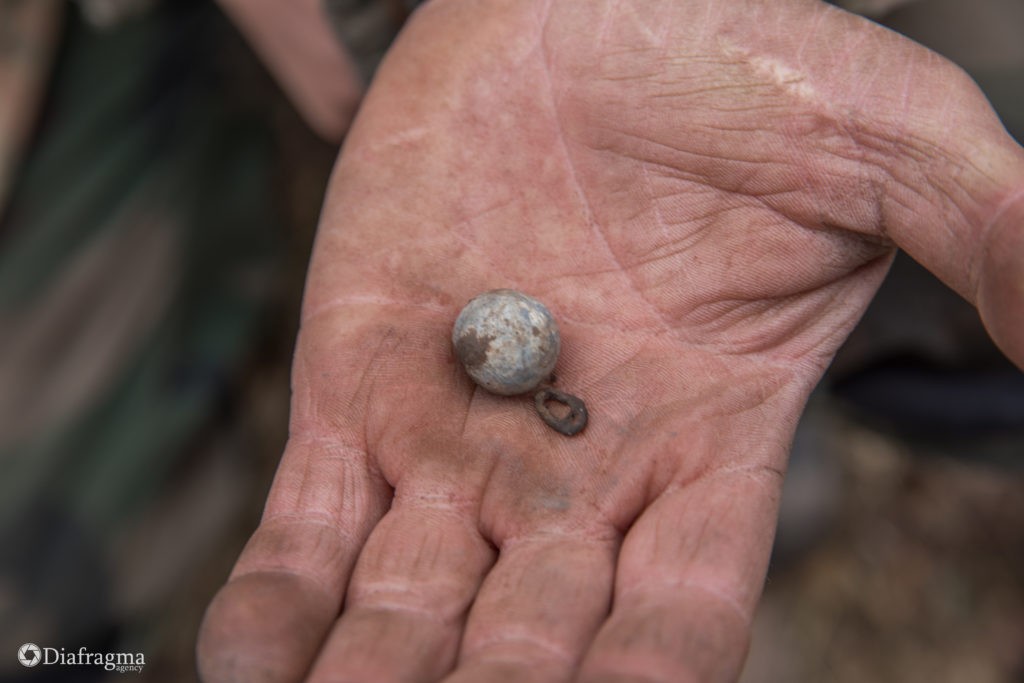
Every day there were more and more discoveries. After studying the surroundings, we were able to localize the place of events: a plot of land approximately 900 by 400 meters was literally covered with various metal objects of that era, indicating that a major battle came about on this field. Then we found lead bullets and a coin minted in the first half of the reign of Ivan the Terrible, which made it possible to significantly narrow the time frame of the battle – the middle of the 16th century.
By now, in these three weeks of archaeological research, more than nine hundred artifacts have been found in the vicinity of the Gogol River: about four hundred arrowheads, more than fifty bullets, many other metal objects, as well as one lead core and a matchlock. All this made an assumption about the discovery of the site of the Sudbischensky battle even more probable. It became one of the first battles in the history of the confrontation between Russia and the Khanate of Crimea, in which both sides used firearms, both relatively heavy and manual. “
This place of historical discovery has attracted many people, scientists, and tourists. The head of the Oryol region – Andrei Klychkov noted : “The event that happened in our region has not only the value of district or regional scale , but at least on an all-Russian, or rather even on a European and global scale.”
Finally, we could note that finds that allow us to accurately contain the battlefield was a rare event. Even though the tactical course of the battle itself has been studied in detail as reported by the sources of the 16th century, the place where it came to pass still remained unknown. However, the spearhead, accidentally found by a diver at the bottom of the river near the village of Sudbischi, initiated a cascade of events that would fill the “blank spot” on the map of the legendary battle.